
Small windows can be charming. They can also be slightly awkward.
In a room with generous proportions, a petite window can look lost against a large wall, leaving the space feeling less balanced than it should. And while you cannot magically add another foot of glass to the window, you can certainly make it look larger.
The secret is not in the window itself. It is in how you dress it.
The right window treatment can visually extend the width, emphasize the height, make the surrounding wall feel more intentional, and even bring more light into the room. Think of it as a little interior-design sleight of hand.
Here are some of the smartest ways to make a small window look considerably more substantial.
1. Mount Curtains Higher Than the Window
One of the oldest tricks in the designer’s book is also one of the most effective.
Instead of mounting the curtain rod directly above the window frame, position it several inches higher. In rooms with generous ceiling height, you can take this idea even further and mount the rod close to the ceiling.
Why does it work?
The eye follows the vertical line of the fabric upward, making the window appear taller than it actually is.
The curtains should ideally extend all the way to the floor. Short curtains can visually emphasize the smallness of the window, whereas long, flowing panels create a stronger architectural line.
For the most polished result, custom curtains allow you to control exactly where the rod sits, how long the panels are, and how much fullness the fabric has.
2. Extend the Curtain Rod Beyond the Window
If the problem is width rather than height, the solution is to think sideways.
Mount the curtain rod several inches beyond each side of the window frame. When the curtains are open, the fabric can stack against the wall rather than covering the glass.
This exposes more of the actual window and creates the impression that the opening extends farther than it does.
It is particularly effective when you have enough wall space around the window.
The trick is to avoid choosing a rod that is only marginally wider than the frame. The more room you have to extend it, the more convincing the illusion can be.
3. Use Full-Length Drapes
A small window does not mean you have to use a small amount of fabric.
In fact, floor-to-ceiling curtains can be one of the best ways to give a petite window more presence.
Custom drapes can be made to extend from near the ceiling all the way to the floor, creating a dramatic vertical frame around even a relatively modest window.
This works especially well in bedrooms and living rooms, where floor-length fabric naturally feels at home.
Choose a fabric with some weight and movement, but avoid anything so bulky that it overwhelms the room. Linen, cotton blends, and softly textured woven fabrics can create an elegant effect without looking overly formal.
4. Try Roman Shades for a Cleaner Look
Curtains are not the only solution.
If your room is small or the window is surrounded by furniture, cabinetry, or architectural details, a roman shade may actually be the smarter choice.
Roman shades fit neatly within the window’s footprint while still allowing you to introduce beautiful fabric, pattern, and texture.
Custom roman shades are particularly useful for small or unusually proportioned windows because they can be made to fit the exact dimensions of the opening.
For an interior with clean lines, a tailored roman shade can make the window feel deliberate rather than undersized.
5. Consider an Outside Mount
Where appropriate, mounting a roman shade outside the window frame can create the illusion of a larger window.
Instead of sitting inside the opening, the shade extends beyond it, covering part of the surrounding wall. The eye therefore reads the entire treatment as the window rather than distinguishing between glass and wall.
This approach can be especially effective for narrow windows.
However, proportions matter. The shade should extend far enough beyond the frame to create a noticeable visual difference without looking disproportionately large for the room.
6. Don’t Cover More Glass Than Necessary
This sounds obvious, but it is surprisingly easy to lose valuable natural light through an oversized treatment.
If you are using curtains to make a small window look larger, keep the fabric stacked away from the glass when the curtains are open.
If you are using a roman shade, consider how much of the window is covered when the shade is raised.
The goal is to frame the window, not hide it.
The more glass you can expose during the day, the brighter and more expansive the room is likely to feel.
7. Use Sheer Fabrics to Let Light Through
Natural light is one of your greatest allies when working with a small window.
Heavy, opaque fabrics can make a petite opening feel even smaller, particularly in rooms that are already short on daylight.
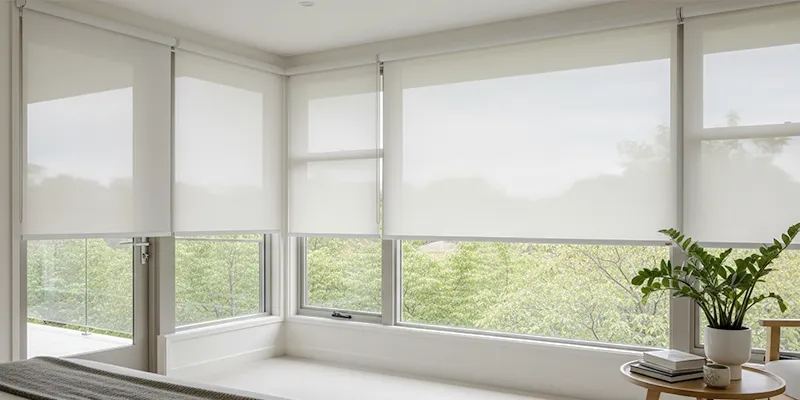
Sheer roman shades offer a softer alternative. They filter sunlight rather than completely blocking it, allowing the window to glow while providing a degree of privacy.
Sheer curtains can achieve a similar effect.
The fabric becomes a luminous layer around the window rather than a visual barrier, making the entire area feel lighter and more open.
This is especially effective in bedrooms, living rooms, and dining spaces where you want to preserve a sense of airiness.
8. Keep the Color Palette Light
Color can dramatically affect how large a window feels.
Light and medium tones tend to blend more easily with the surrounding architecture, allowing the window treatment to feel like an extension of the wall.
Soft white, ivory, cream, pale gray, beige, and gentle taupe can all work beautifully.
This does not mean you have to avoid dark colors altogether. A deep charcoal or navy treatment can create a sophisticated focal point, but it will naturally attract more visual attention to the window.
If your primary goal is to make the window disappear into a larger composition, keep the treatment relatively close in tone to the walls.
9. Or Go Bold and Make the Window a Feature
There is another approach: stop trying to disguise the small window.
Instead, make it a deliberate focal point.
A striking fabric can turn a modest window into a decorative feature. Think dramatic stripes, oversized botanicals, rich velvet, or a sophisticated geometric print.
Patterned curtains can be particularly effective because the eye registers the entire expanse of fabric rather than focusing solely on the glass.
The trick is to give the pattern enough room to breathe. Extending the curtains beyond the window and taking them to the floor creates a much more substantial visual statement.
Rather than asking the window to look bigger, you are making the window treatment important enough that its actual size becomes irrelevant.
10. Use Vertical Stripes to Add Height
Stripes are one of the easiest patterns to use when you want to influence perceived proportions.
Vertical stripes naturally draw the eye upward, which can make a small window appear taller.
This works particularly well with curtains because the full-length fabric reinforces the vertical movement.
For a subtle interpretation, choose narrow stripes in two similar tones. For a more dramatic room, consider stronger contrast.
Horizontal stripes can also be useful, but they have the opposite effect. They emphasize width rather than height.
Choose according to the proportion you want to enhance.
11. Create a Continuous Visual Line
If you have multiple small windows on the same wall, treating each one as an isolated opening can make the wall feel fragmented.
Instead, consider visually connecting them.
A continuous curtain treatment across several windows can make the entire wall feel more expansive. Even when individual windows are small, the overall composition reads as one large architectural feature.
The same principle can sometimes be applied with roman shades, particularly when the windows are arranged symmetrically.
The objective is to create rhythm rather than a collection of disconnected rectangles.
12. Pay Attention to Fullness
Curtain fullness can make an enormous difference.
Too little fabric can make curtains look skimpy and emphasize the modest scale of the window. Generous fullness creates softness, movement, and visual weight.
This does not mean every curtain needs to be extravagantly gathered. The appropriate amount depends on the fabric and the style of the room.
Lighter fabrics can generally handle more fullness, while heavier fabrics may require less.
If the curtains are intended to remain mostly closed, you will need more fabric than if they are primarily decorative panels framing the window.
13. Match the Treatment to the Architecture
A window treatment can make a small window look larger, but it should still make architectural sense.
If the window sits beneath a low ceiling, taking curtains all the way to the ceiling may be particularly effective.
If the window is surrounded by built-ins, however, a roman shade may integrate more naturally.
If there is beautiful trim around the opening, you may not want to cover it at all. In that case, an inside-mounted shade can preserve the architectural detail while still giving the window a polished finish.
The best visual trick is always the one that looks effortless.
14. Don’t Ignore the Rest of the Room
Finally, remember that the perceived size of a window is influenced by everything around it.
A small window surrounded by oversized furniture can feel even smaller. Heavy artwork placed immediately beside it can make the wall appear crowded. Too many contrasting colors can also draw attention to the window’s actual proportions.
Instead, think about visual balance.
Give the window enough breathing room. Keep nearby furniture appropriately scaled. Use the treatment to connect the window with the larger color and texture palette of the room.
Sometimes the solution is not simply a bigger curtain or shade.
It is a better relationship between the window and everything around it.
Small Window, Big Impact
Small windows do not have to limit your design ambitions.
With the right treatment, a petite window can become a beautifully framed architectural feature, a source of soft natural light, or even a dramatic focal point.
Use curtains to create height and width. Consider roman shades when you want a cleaner silhouette. Let sheer fabrics filter rather than block daylight. Extend treatments beyond the frame where the architecture allows it, and pay close attention to color, pattern, fullness, and proportion.
Most importantly, decide what you want the eye to see.
If you want the window to feel larger, extend its visual boundaries. If you want it to feel more important, make the treatment a feature. And if you simply want the room to feel brighter and more spacious, prioritize light.
Because when it comes to interior design, size is often less important than perception.
And a beautifully dressed small window can have a surprisingly big presence.